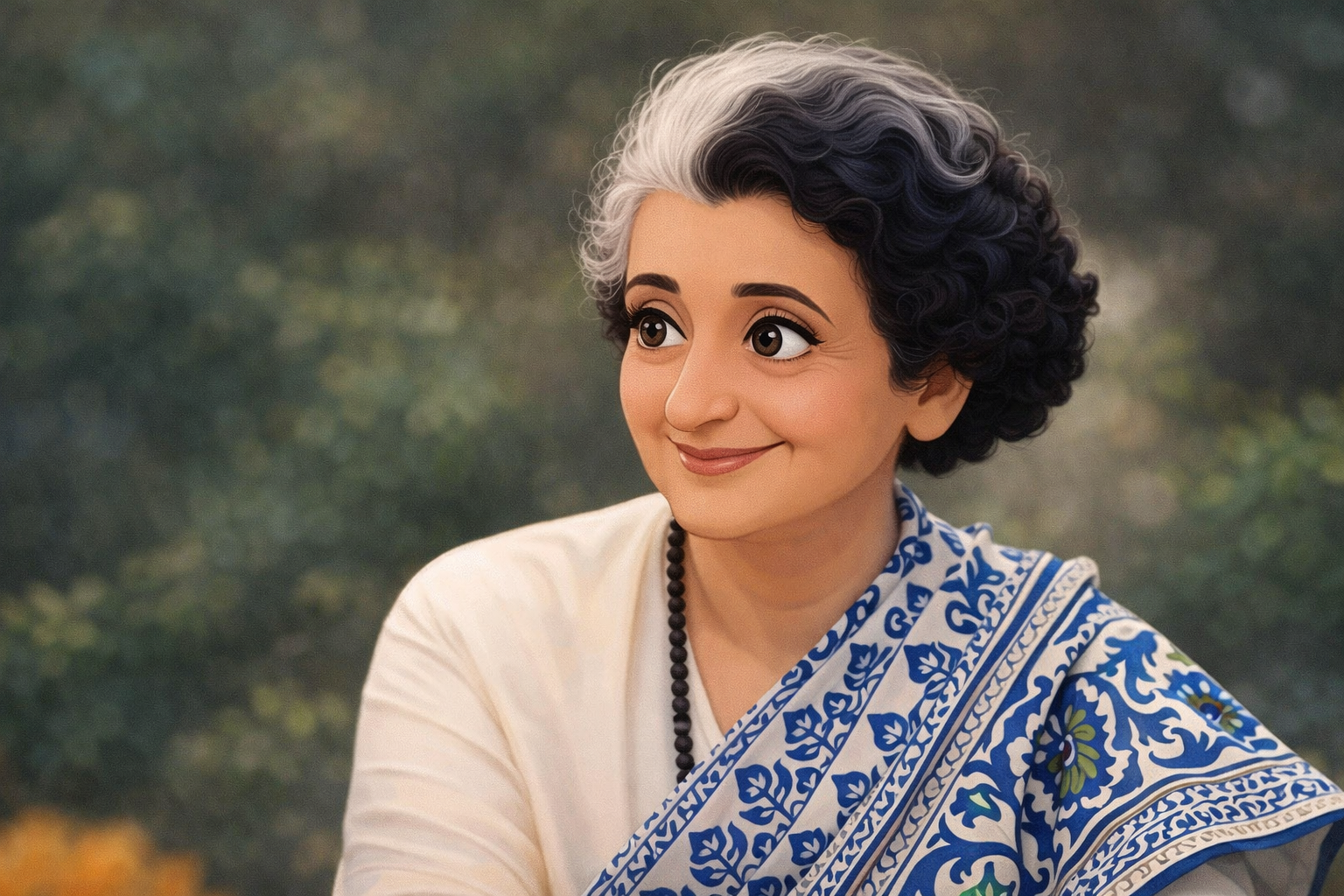
In Allahabad, on November 19, 1917, a child was born into a home where struggle and hope lived side by side.
Her father, Pandit Jawaharlal Nehru, was already a towering figure in India’s freedom movement.
Her mother, Kamala Nehru, was gentle, brave, and often unwell.
Their home was not quiet — it was a revolution disguised as a household.
From the beginning, the young girl breathed politics as naturally as air.
She learned early that freedom had a price — and her family paid it again and again.
They named her Indira Priyadarshini.
The world would one day know her as Indira Gandhi — India’s first and only woman Prime Minister.
A Childhood in the Shadows of Prison Walls
As a child, she watched the British imprison her father repeatedly.
She wrote him letters filled with longing, pride, and questions far deeper than her age.
Her mother’s health weakened. Her home felt emptier. But her resolve grew stronger.
“Even as a child, I learned that courage is not loud. It is simply refusing to bow.”
Loneliness shaped her. Responsibility trained her. The freedom movement raised her.
Becoming Indira
Indira studied in India, Switzerland, and Oxford. Her education was not just academic — it was emotional.
She learned resilience from her mother’s frailty. Patience from her father’s long absences. And discipline from the demands of public life.
When India finally breathed freedom in 1947, Indira was there — not as a spectator, but as part of the Nehru household that helped build a newborn nation.
In 1942, she had married Feroze Gandhi, a relationship full of affection but also complexities.
Life was never simple for her — but she kept walking.
The Rise to Leadership
After Nehru became India’s first Prime Minister, Indira worked quietly by his side — observing, listening, absorbing.
She served as Congress President in 1959, then as a cabinet minister.
Her learning was not from textbooks — it was from history unfolding at her doorstep.
When Lal Bahadur Shastri passed away unexpectedly in 1966, she became Prime Minister — a role that would define her, test her, and transform her.
She was not yet the “Iron Lady.” That title would come later.
The Woman Who Walked Into Storms
Indira Gandhi governed in some of the most turbulent decades of India’s history — filled with challenges, crises, wars, internal tensions, and global pressures.
Her leadership was bold, controversial, decisive, and often polarising — but never passive.
She took decisions that shook the world.
She stood firm even when the ground trembled.
And she carried the weight of a vast nation on her shoulders like someone who had been preparing for it since childhood.
Whether praised or criticised, she remained composed — a woman who had learned early that solitude is also a strength.
“People think strength means hardness. But real strength is the ability to stand alone when needed.”
The Green Revolution
Under her leadership, India took critical steps in agriculture that helped transform chronic shortages into abundance.
She pushed for self-reliance, for science, for modernisation — not as slogans, but as survival.
This era shaped her legacy as someone who believed India could — and must — stand on its own feet.
The Dark Hours & The Shadow of the Emergency
Her tenure saw moments of deep crisis, including the Emergency (1975–1977) — a period that remains one of the most debated chapters in Indian democratic history.
The Emergency changed how the world saw her.
And it changed how she saw herself.
This part of her story is not told with judgment here — only with honesty: it marked her, defined her, and followed her forever.
Return & Redemption
After losing power in 1977, many thought her political journey was over.
But she returned — stronger, sharper, more determined — winning the 1980 elections.
Few leaders in history have staged such a dramatic comeback.
The Final Act
The 1980s brought new storms — violent unrest, internal conflict, and rising tensions.
She made decisions she believed necessary, knowing well the risks.
On October 31, 1984, she was assassinated by her own bodyguards — a moment that shook India to its core.
She was 66. A leader. A mother. A daughter of the freedom struggle.
A woman who lived inside the fire of history.
The Legacy
Indira Gandhi remains one of the most complex and compelling figures in India’s story.
Admired, criticised, remembered, debated — never forgotten.
Her life was not a straight line — it was a storm. And she stood in its center with unbroken resolve.