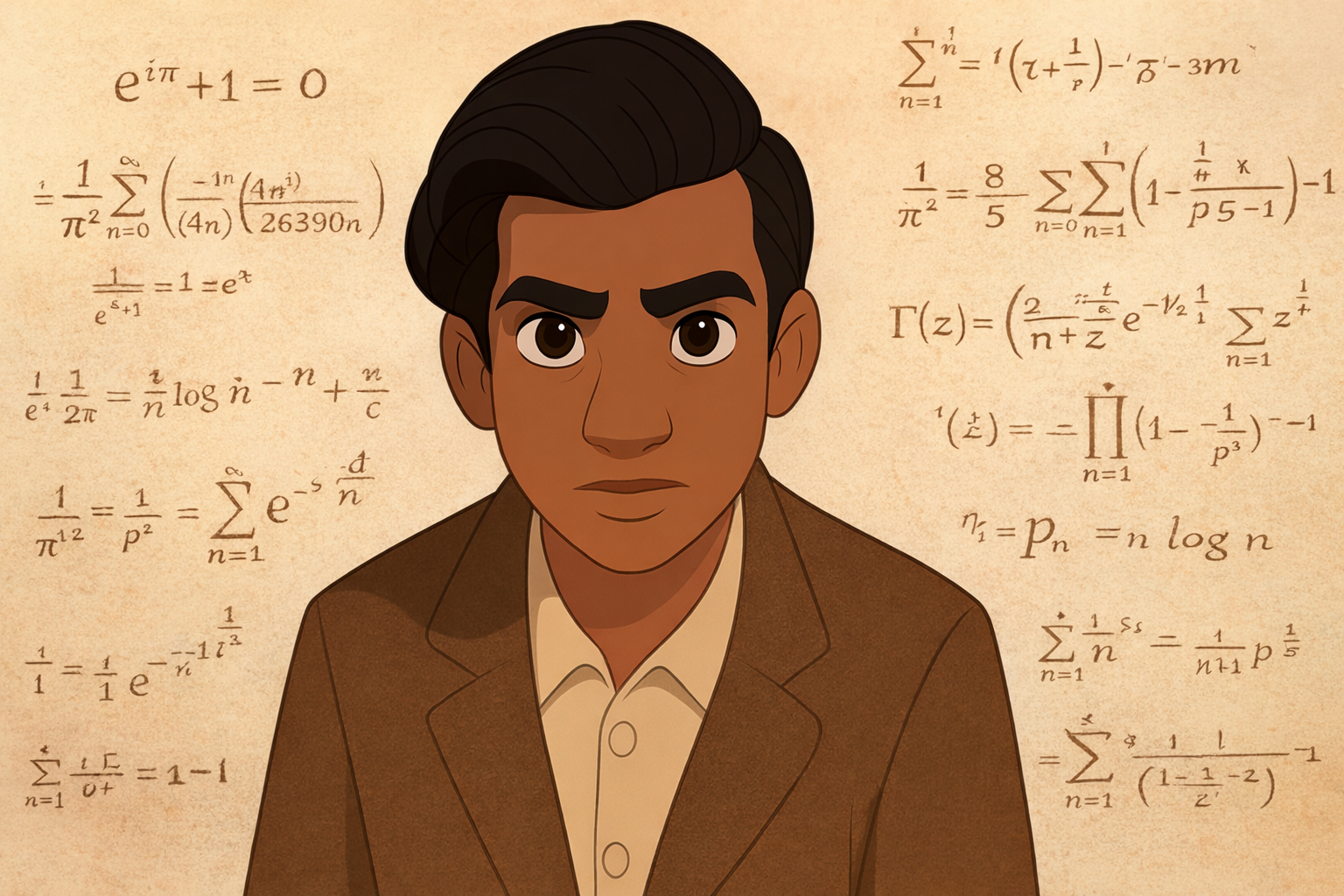
In 1887, in the temple town of Erode, Tamil Nadu, a child was born into a modest Brahmin family.
His father worked as a clerk. His mother sang devotional songs and worshipped Goddess Namagiri.
They named him Srinivasa.
From the beginning, he belonged to silence.
A Mind That Saw Patterns Everywhere
As a boy in Kumbakonam, Ramanujan did not play like others. He stared at numbers the way poets stare at the moon.
At sixteen, he found a book — A Synopsis of Elementary Results in Pure and Applied Mathematics. It changed his life.
Without teachers, without guidance, he began rediscovering mathematics on his own — writing formulas that had taken centuries to evolve.
He filled notebooks with results — no proofs, only truths.
“An equation means nothing to me unless it expresses a thought of God.”
Poverty and Faith
Genius did not bring comfort.
He failed college — not because he lacked brilliance, but because numbers consumed him and everything else faded.
He lived in poverty, often hungry, dependent on small jobs and charity.
Yet his faith never wavered.
He believed his insights came in dreams — whispered by Namagiri herself.
To many, he looked lost.
To numbers, he was home.
A Letter to the Unknown
In 1913, from a small room in Madras, Ramanujan did something extraordinary.
He wrote to a professor in England — enclosing pages filled with formulas no one had seen before.
That professor was G. H. Hardy of Trinity College, Cambridge.
Hardy opened the letter — and froze.
He later said:
“They must be true, because if they were not, no one would have the imagination to invent them.”
Ramanujan was invited to England.
Cambridge: Between Cold and Fire
England was harsh — cold weather, unfamiliar food, cultural isolation.
Ramanujan’s health suffered. His loneliness deepened.
But mathematically — he exploded.
Together with Hardy, he produced results that reshaped number theory:
Infinite series. Partition functions. Continued fractions. Mock theta functions — decades ahead of their time
Hardy called him:
“A mathematician of the highest class — comparable to Euler.”
Ramanujan never argued. He simply wrote.
The Price of Infinity
Illness followed him relentlessly — tuberculosis, malnutrition, exhaustion.
In 1919, he returned to India — fragile, but still creating.
Even from his sickbed, numbers visited him.
His last letter spoke of strange new functions — ideas the world would only understand nearly a century later.
On April 26, 1920, at just 32 years old, Ramanujan left the world.
Quietly.
Without applause.
Without knowing how far he had reached.
The Eternal Legacy
Ramanujan left behind notebooks that continue to inspire mathematics today — influencing physics, cryptography, string theory, and computer science.
He was not trained by institutions. He was tuned to the universe.
Hardy once said:
“Ramanujan was a natural genius — like a flower growing in the wild.”