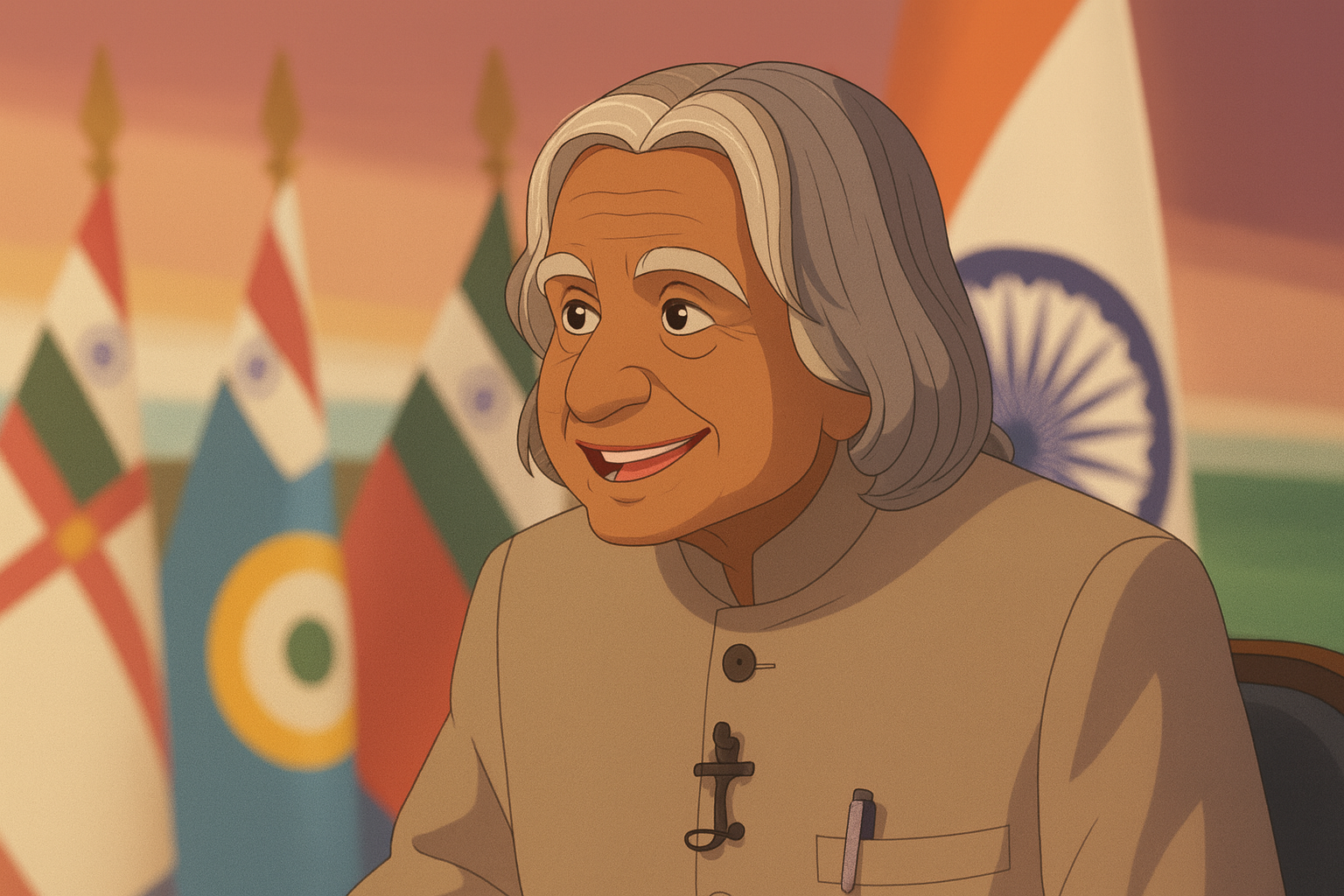
In Rameswaram, a small temple town by the sea in southern India, a boy was born on October 15, 1931.
The waves of the Bay of Bengal washed near his home; the rhythm of the ocean became his first teacher.
His family was poor but proud — his father, Jainulabdeen, was a boat owner and imam; his mother, Ashiamma, cooked and fed anyone who came hungry.
They taught him one truth:
“Wealth is not in what you have, but in what you give.”
That boy was Avul Pakir Jainulabdeen Abdul Kalam.
The world would later call him — “The People’s President.”
The Boy Who Looked at the Sky
Every morning before sunrise, he would deliver newspapers to help his family.
But at night, he would sit by the shore, gazing at the stars.
Airplanes passing above became his daydreams. He once told his friends,
“One day, I will fly something that touches the sky.”
He studied hard, against all odds, and earned a degree in aeronautical engineering from the Madras Institute of Technology.
He was not born privileged — but he was born curious.
The Scientist Who Built Wings for India
Kalam joined ISRO (Indian Space Research Organisation) in the 1960s, when India had no satellites, no rockets, and little funding.
What it had — was belief.
He led the team that developed India’s first indigenous satellite launch vehicle (SLV-III), which successfully placed the Rohini satellite into orbit in 1980.
It was India’s first step into space.
The boy from Rameswaram had touched the sky — and helped his nation do the same.
“Dream is not what you see when you sleep — dream is what keeps you awake.”
Later, as part of DRDO (Defence Research and Development Organisation), he spearheaded India’s missile program — creating Agni, Prithvi, and the technology that made India self-reliant in defense.
He became known as the Missile Man of India — but his eyes always held humility, never pride.
The Leader Who Dreamed Beyond Science
In 1998, India conducted its Pokhran-II nuclear tests, marking a moment of strategic independence.
Dr. Kalam stood quietly behind the success — calm, composed, and grateful. He said simply,
“Strength respects strength.”
But his greatest power was never his intellect — it was his ability to inspire.
In classrooms, auditoriums, and humble schools, he would tell children:
“You were born with wings. Don’t crawl — learn to fly.”
He believed education was sacred.
He believed every child could change India.
And he believed that science was not just invention — it was service.
The People’s President
In 2002, Dr. A. P. J. Abdul Kalam became the 11th President of India — one of the most beloved in history.
He brought no political agenda, only purpose.
He turned Rashtrapati Bhavan — the grand presidential palace — into a classroom. He invited students, scientists, dreamers. He played the veena. He read the Gita and the Quran.
He was everyone’s teacher. Everyone’s mentor.
“To succeed in your mission, you must have single-minded devotion to your goal.”
The Teacher Who Never Stopped Teaching
Even after leaving office, he never slowed down. He traveled across India, meeting millions of students, speaking of dreams, discipline, and devotion.
His words reached villages where dreams rarely did.
He showed children that science could be poetry, that faith could coexist with reason, and that kindness was the highest form of intelligence.
On July 27, 2015, while delivering a lecture at the Indian Institute of Management, Shillong, he collapsed on stage — doing what he loved till his final breath: teaching.
He died as he lived — in service, with purpose, and in peace.
The Eternal Flame
Dr. Kalam left behind no wealth, no heirs — only an idea:
that a nation becomes great when its people dream greatly.
“If you want to shine like the sun, first burn like the sun.”
“Excellence happens not by accident — it is a process.”
“You have to dream before your dreams can come true.”
He remains the bridge between science and spirituality, humility and greatness, India and its dreams.